How to Plan a Mobile Caterer Event in Lakewood When Your Venue Has Strict Noise and End-Time Rules
What You'll Learn
- Build a timeline that protects dinner, speeches, and cleanup
- Match food service pace to venue curfews and quiet hours
- Reduce cutoff risks with smarter entertainment scheduling
- Plan mobile caterer logistics that fit restricted sites
- Create a polished guest experience without last-minute stress
Planning a celebration with a mobile caterer in Lakewood can be a smart way to create a flexible, memorable event, but strict venue rules change how every part of the day should be scheduled. Whether you are hosting on private property, at a neighborhood venue, or at a commercial site with firm quiet hours, the best results come from building the timeline around restrictions first, not treating them as an afterthought. A polished event depends on realistic arrival windows, food service pacing, entertainment timing, and a clear shutdown plan so guests enjoy the experience without a rushed ending.
For homeowners and business owners, the biggest mistake is assuming a posted end time only affects music. In reality, a hard stop can affect vendor access, generator use, amplified sound, bar service, lighting, trash removal, and even when the mobile caterer in Lakewood is allowed to finish service. If you want the event to feel smooth instead of compressed, start by identifying what time music must be lowered, what time guests must leave, and what time all vendors must be fully out. Those are three different deadlines, and each one matters.
Start With the Venue Rules, Then Build Backward
An experienced planner begins with the non-negotiables: quiet hours, amplified sound limits, parking restrictions, truck placement rules, and final load-out time. From there, the timeline is built backward so dinner, toasts, and guest transitions fit the available window. If you are comparing options for event flow, it helps to review timing frameworks like this guide to coordinating ceremony timing, cocktail hour, and dinner service and this overview of event flow planning for mobile catered weddings. The principle is the same in Lakewood mobile caterer planning: every major moment needs buffer time.
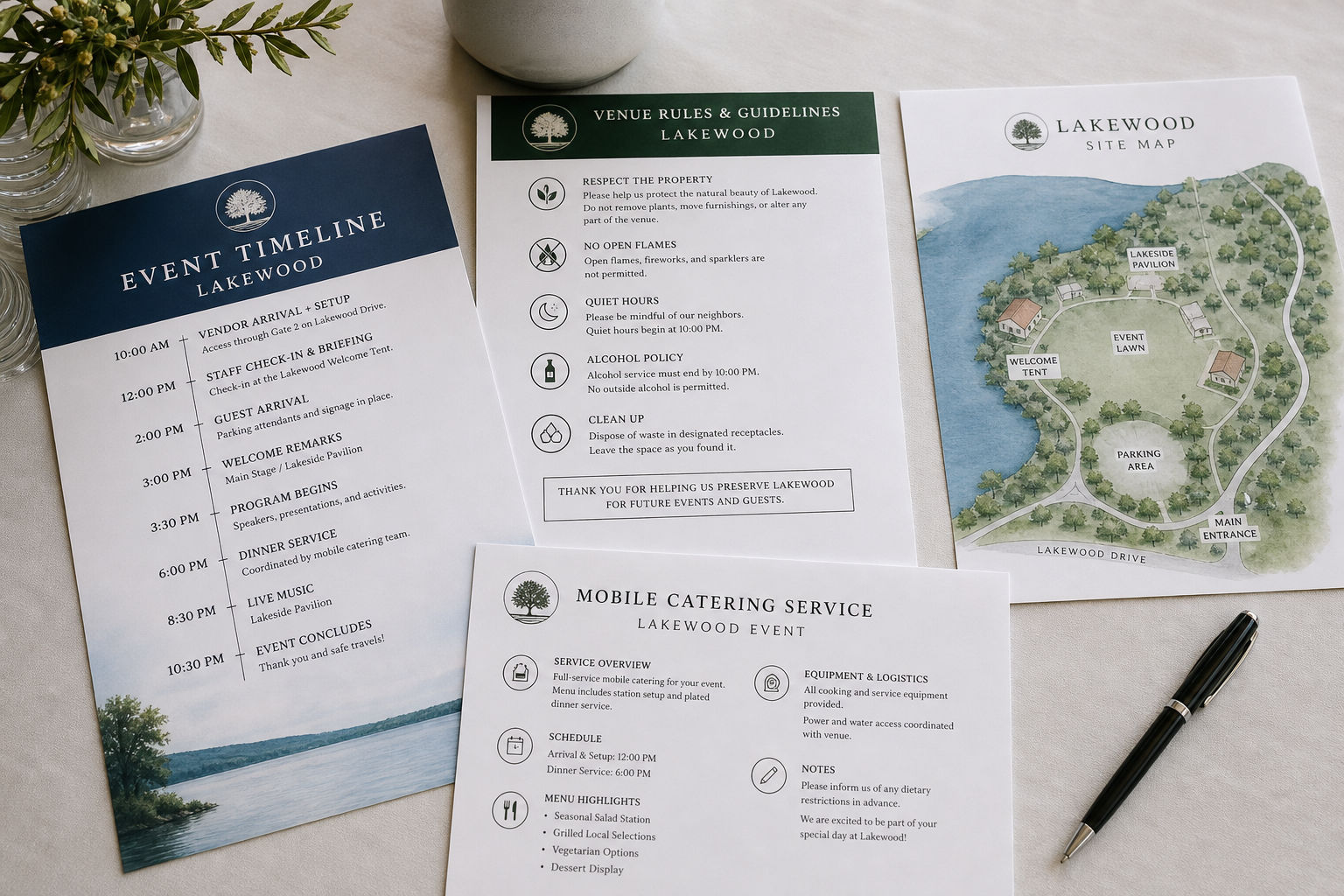
For example, if your site requires music off at 9:30 p.m., guests out by 10:00 p.m., and vendors off property by 10:30 p.m., dinner cannot casually begin at 8:15 p.m. and still leave room for speeches, dessert, and a comfortable social period. Instead, a planner may recommend earlier guest arrival, a shorter cocktail hour, or a streamlined service format. This is not about making the event feel rigid. It is about protecting the guest experience by preventing the final hour from becoming a scramble.
- Confirm quiet hours, guest departure time, and vendor load-out deadline
- Ask when the truck may arrive, serve, and begin breakdown
- Identify where amplified sound is allowed and when it must stop
- Leave buffer time between major moments, not just exact start times
Shape the Food Service Plan Around the Curfew
Food service is often the centerpiece of the event, so it needs to work with the clock instead of fighting it. A mobile caterer in Lakewood must know not only the guest count, but also when guests will be ready to eat, how long service can realistically take, and whether the venue allows service to continue during speeches or entertainment. If the property has a strict end time, the service model should favor efficiency and consistency. That may mean simplifying menu timing, tightening the release of tables or guest groups, and deciding in advance whether dessert is served immediately after dinner or repositioned earlier in the evening.
Hosts often underestimate how much transition time matters. Guests need time to move from ceremony or welcome activities into the meal period, and the truck may need a stable window to serve at full pace. For a deeper look at practical timing, see these wedding reception timelines that work with mobile catering. The lesson applies broadly: the cleaner the event flow, the less likely you are to lose valuable minutes to confusion, lines, or delayed announcements.
In Lakewood, a well-planned mobile catering schedule also accounts for setup access and site limitations. If the truck cannot enter until a certain hour, that changes when service can begin. If parking is tight or power access is limited, those logistics should be solved before invitations go out. Helpful planning examples can be found in this post on parking, power, and site access challenges. The more realistic the setup plan, the easier it is to keep the event on time.
Schedule Entertainment So the Night Ends Strong
Strict noise rules do not mean an event has to feel flat. They simply require smarter sequencing. High-energy entertainment should happen while sound levels are fully permitted, not after the venue begins reducing volume. If there will be speeches, presentations, or a first dance, those moments should be scheduled early enough that they do not compete with meal service or get pushed into the final minutes. A strong planner protects the emotional high points of the event by placing them where guests are attentive and the venue rules are still working in your favor.
For business owners hosting client-facing or employee events, this is especially important. A rushed ending can leave the impression that the event was underplanned, even if the food was excellent. If you are organizing a company gathering with a mobile caterer in Lakewood, it is useful to think through host responsibilities in advance, similar to the preparation advice covered in this article for local business owners before hiring an event planner. The clearer the internal decision-making is, the easier it is to keep the event polished from start to finish.
Build in Buffers for Real-World Delays
No event runs exactly to the minute. Guests arrive late, announcements take longer than expected, and weather can slow transitions. That is why a professional timeline includes buffers between key segments. A Lakewood mobile caterer event should not be scheduled so tightly that one delayed toast forces dinner service, dessert, and cleanup into the same compressed window. Even a ten-minute cushion before meal service or before entertainment can prevent a chain reaction that affects the entire evening.
This is particularly true for outdoor events or properties with neighborhood sensitivity. If conditions change, you need room to adapt without violating restrictions. While every event is different, the planning mindset is similar to the contingency thinking outlined in this guide to rain, wind, and heat strategies for outdoor celebrations. Strong events do not rely on perfect conditions; they are built to stay organized when conditions shift.
Questions Hosts Should Settle Early
Before you finalize your date and guest communication, clarify the operational details that most often create last-minute problems. Homeowners planning private celebrations and business owners arranging hosted events both benefit from asking these questions at the start. If you want a broader planning checklist, this post on what to ask before hiring an event planner offers a useful framework. For a mobile caterer in Lakewood, these answers directly affect the timeline, staffing assumptions, and guest flow.
- What exact time must food service end?
- When must music be lowered or stopped entirely?
- How long does guest departure typically take at this site?
- When can vendor breakdown begin without disrupting guests?
- Who is responsible for monitoring the clock on event day?
Why Good Planning Makes the Event Feel More Relaxed
The goal of structure is not to make the event feel over-managed. It is to create enough clarity that everyone can relax. When the mobile caterer in Lakewood, host, venue, and entertainment team all understand the sequence, guests experience smooth transitions, shorter waits, and a more confident pace. That is what makes an event feel premium. The timeline is not just a document; it is what protects hospitality.
If your venue has strict noise or end-time rules, the smartest move is to plan around them from day one. A realistic timeline, an efficient food service plan, and a well-sequenced entertainment schedule will help your mobile caterer in Lakewood deliver an event that feels polished rather than rushed. For homeowners and local business owners, that preparation is what prevents last-minute cutoff problems and keeps the celebration focused on guests instead of logistics.
Source: review local noise guidance